
⭐ We’re back!
The best blockchain-themed journalism and research this winter — so far

Hey ACJR readers,
The newsletter is officially back!
Yes, you might have received a stray edition or two over the past few months as the 2026 ACJR board elections took place. But this is the first, real, complete and revamped ACJR newsletter fully back in action — and it’s written (yet again) by ACJR president Molly Jane Zuckerman and (new) ACJR board member Ben Schiller.
Let’s dig right in — it’s a new year, and a new board.
President: Molly Jane Zuckerman, newly unemployed (formerly: Blockworks)
Vice president: Olivia Capozzalo, The Defiant
Treasurer: Sean Stein Smith, Associate Professor, Lehman College - CUNY Faculty Fellow - Chair, Wall Street Blockchain Alliance (Accounting Working Group)
Associate: Ben Schiller, Miden (formerly: CoinDesk)
David Canellis, Blockworks, was elected secretary but has resigned.
With the introductions out of the way, we’ll tease a few upcoming events — an in-person ACJR journalism awards ceremony at Consensus this spring, and a few meetups around the world (also coming soon).
We also have a guest piece by Jon Rice (former editor-in-chief of Cointelegraph, Blockworks and Crypto Briefing) closing out our newsletter entitled Where Cointelegraph went horribly, horribly wrong (and why it’s not alone) — that should be enough to keep y’all scrolling till the very end.
Have an idea for what you want to see out of the ACJR this year? Reach out to president Molly Jane (me) on Telegram @mollyjanez with your thoughts.
₿ 😎 ₿
Top crypto journalism this winter
Berachain Documents Show Brevan Howard Fund Offered $25 Million Refund Right
By Jack Kubinec, Unchained
An arguably explosive investigation into Berchain’s complex Series B terms — a must-read.
The Aave dispute, the glory of a DAO, and the discomforts of DeFi growing up
By Brady Dale, Front Stage Exit
Dale unpacks Aave’s governance drama, as only he can.
Prediction markets barely make money; sportsbooks make money
By Sam Learner, FT
Kalshi is 90% sports betting but its CEO rarely mentions it. Why?
Small-time crypto investors are facing violent attacks
By Austin Carr, Bloomberg
Diving deep into the ugliest phenom in crypto: kidnapping.
And now — it’s research time.
₿ 😎 ₿
Top crypto research & policy this winter
Galaxy Research Newsletter, 12/19/25
By Zack Pokorny, Galaxy
“To borrow from Mark Twain, reports of general-purpose L1s’ death have been greatly exaggerated.”
The CoinAlg Bind: Profitability-Fairness Tradeoffs in Collective Investment Algorithms
By Andrés Fábrega, James Austgen, Samuel Breckenridge, Jay Yu, Amy Zhao, Sarah Allen, Aditya Saraf, Ari Juels, Cornell University
Collective Investment Algorithms (CoinAlgs), an increasingly popular investment strategy, “cannot ensure economic fairness without losing profit to arbitrage,” a new research report says.
Agentic Payments and Crypto’s Emerging Role in the AI Economy
By Lucas Tcheyan, Vikram Singh, Galaxy
The one where we find out how important AI agents could be to cryptocurrency.
From Infinite Upside to Finite Math
By Eylon, Building Blocks
Quoting Silicon Valley to explain where buybacks, fees and revenue are in crypto today.
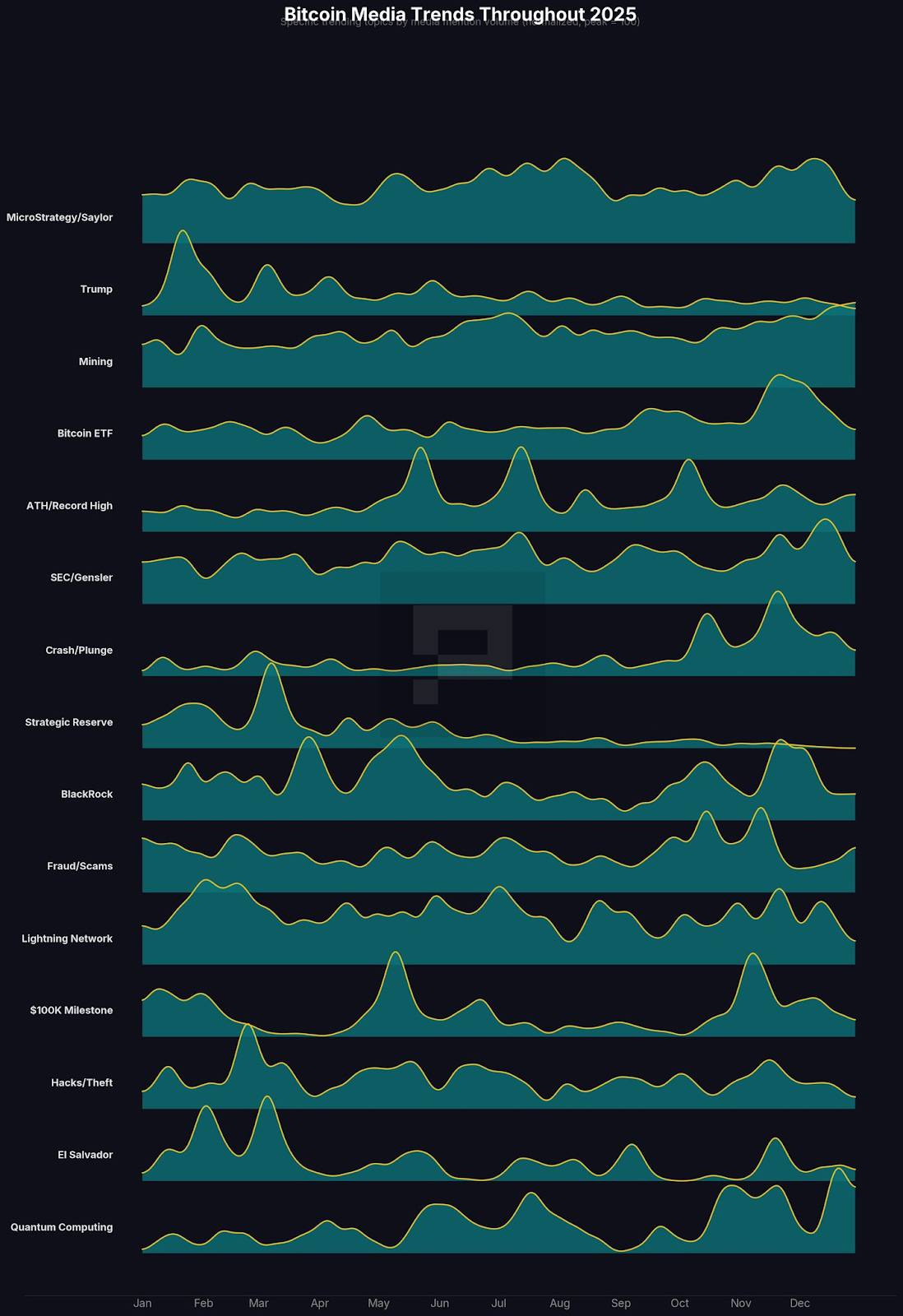
The Wrong Story: What 354,000 Media Mentions Reveal About Bitcoin in 2025
By Fernando Nikolic, Perception
TLDR: Michael Saylor and mining continue to dominate media mindshare. The quantum threat (to encryption) was a coming issue by 2025’s end.
₿ 😎 ₿
Top crypto video this winter
Ranking Crypto Media: The Best and Worst for 2026, Blockspace Media
As ACJR co-founder Joon Ian Wong said — “This should have been an ACJR thing.” A must watch to understand the state of crypto media, as understood by crypto media (specifically the aforementioned Brady Dale, a veteran operative).
And an honorable mention goes to Gareth Jenkinson at Cointelegraph with his podcast episode about how 1 million Ugandans have downloaded decentralized messaging app Bitchat before the country’s presidential elections.
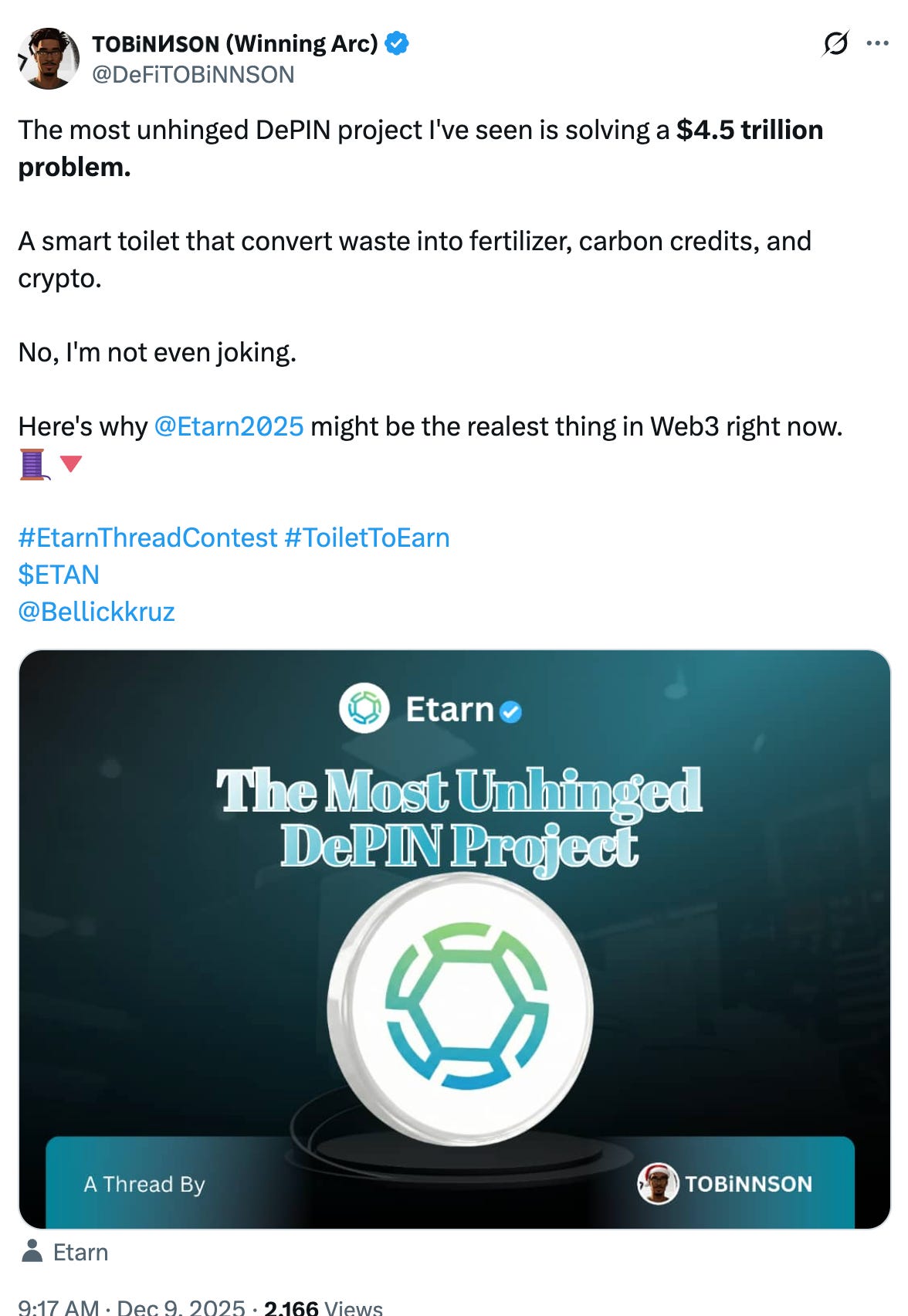
Top crypto unhinged tweet this winter
Where we could do better
And now, the ACJR newsletter would like to give space to the recently-former editor-in-chief of Cointelegraph (and ACJR founder) Jon Rice.
If you are in the ACJR Telegram group, you may have already seen this story — if not, newsletter subscribers can read what happened at Cointelegraph in Jon’s own words.
Where Cointelegraph went horribly, horribly wrong (and why it’s not alone)
In October of 2025, Cointelegraph disappeared from Google results.
News. Discover. Search. All gone.
Was this the start of a new clampdown on crypto content? A major algorithm shift that would affect its competitors as well?
No. It was the direct result of a decision made by the CEO of the organization to engage in a paid partnership with a parasitic blackhat SEO firm, one that hijacks the domain authority of the partner to promote affiliate links to offshore casinos and betting platforms.
This is explicitly against Google’s terms of service. And despite apparently being forewarned earlier in 2025 by Google itself — and despite further warnings throughout the year from the three most senior editorial staff at the company — the CEO, who has no previous media experience, waved away concerns. The result, predictably, was a manual penalty which entirely de-platformed the outlet.
Instead of showing up at the top of countless crypto queries, the #1 result for a “Cointelegraph” search is now…CoinDesk.

It is hard to express how catastrophic this has been for Cointelegraph, but as the former editor-in-chief, I’ll give it a shot.
From an average of around 8M visits per month until October, Cointelegraph plunged to ~1.4M visits in December according to SimilarWeb (and in line with what I saw) — less than half the traffic of CoinDesk today, and comparable to The Block. That’s an 80% drop in three months.
Now let’s run this to its logical conclusion.
Cointelegraph’s value proposition to advertisers, on which it depends, was always fairly simple: It had the widest reach in the industry. For that reach, advertisers paid a premium price.
Maintaining that reach meant that the publication had to publish more content, more frequently, than its competitors — just under a thousand stories a month.
Once the reach diminishes, the premium disappears. Once the revenue collapses, Cointelegraph can’t afford to pay enough reporters and content creators to sustain a thousand stories a month. Once the frequency and volume disappear, the reach and revenue is further compromised.
Cointelegraph has now entered a classic death spiral.
Media companies have different business models and different strengths, just like companies in any other industry. Toyota SUV engineers are tasked with building the very best all-round vehicle a Toyota SUV can be. Ferrari engineers aim to build the fastest Ferrari possible. Each demands exceptional talent, each has four wheels and an engine, but the end product is very different.
It’s no different in the media.
CoinDesk was the gold standard for quality reporting…until its management screwed up and compromised its editorial integrity by firing its top editors. Result: Significant talent drain.
Cointelegraph reached more retail investors than anyone else…until its management screwed up and tanked its traffic. Result: Existential threat to business.
The Block wooed institutional readers and cultivated a Bloomberg-esque image…until its previous management screwed up and took undisclosed funds from Sam Bankman-Fried. Result: Years of reputational damage.
Blockworks had a stellar newsroom…until management screwed up, fired everyone, and pivoted to a so-so data product. Result: Countless VC dollars and enormous community goodwill tossed aside.
Seeing a pattern here, by any chance?
It’s not just journalists who end up paying the price for the failures of media owners…the entire industry does.
Crypto deserves, and should be able to sustain, a couple of serious and well-intentioned news outlets. It’s vital to the health of our industry.
And although quality journalists such as Laura Shin (Unchained) and Cami Russo (The Defiant) continue to build their brands, media requires deeper pockets than most journalists are able to muster.
Does the answer lie with decentralized media? With the notable exception of Zack Guzman’s Coinage Media, nothing substantial has been built with a decentralized model.
This needs to change. Although all of the major media outlets mentioned above persist (at least for now) they will continue to be subject to the capricious whims of crypto exchanges, VC firms, and individuals with little media expertise…and even less love for the journalists and editors who have to resist their attempts to meddle in the newsroom.
For now, perhaps spare a thought for the Cointelegraph writers and editors who are diligently going about their jobs even as management grapples with the realization that their entire business is very likely ruined.
If CoinDesk was worth $76M to Bullish and The Block was valued at around $70M when Foresight Ventures came in, what was Cointelegraph’s audience (and surprisingly significant revenue) worth at its height?
$125M? $200M? More?
And what’s it worth today?
Cointelegraph has driven away its audience, its advertisers, and is now in the process of losing its talent. (I resigned on December 31st in protest at the egregious mismanagement of the company on many levels, of which this is merely the most prominent example.)
Perhaps when media owners and operators begin to recognize that sidelining expertise often leads to the destruction of value, they’ll have a little more respect for the people in their organizations who actually understand the industry.
Let’s hope 2026 is a better year for crypto-native media.
Jon Rice is the former editor-in-chief at Cointelegraph, Blockworks, and Crypto Briefing.
The opinions in this guest post do not reflect the opinions of the ACJR, the board or its members.
Join the ACJR
It’s easy to join the ACJR — journalist memberships are only $25 a year. If you want access to our members’ only chat, discounts for conferences and invites to meetups, sign up here.
Find the ACJR on Telegram and Twitter.
₿ 😎 ₿